


Like soup tossed out because it lacks a pinch of salt, in the triangle of Melrose Ave, a 10-year, $1 million deal has fallen apart for lack of two seats in a private dining room.
As the Melrose Project takes shape and gathers acclaim as a locavore mecca bringing together some of the most talented food and drink purveyors in Seattle, CHS has learned details of the legal battle pitting star chef Tamara Murphy against Melrose Project developers Scott Shapiro and Liz Dunn, two of the most prominent names in Capitol Hill real estate. In the wings, a third party waits as another group involving all-star Seattle foodies is poised to replace Murphy’s Terra Plata in the project after the legal dispute is settled. But Terra Plata isn’t going down easily.
CHS first reported on signs of trouble in March when we found a letter detailing $46,000 in rent and expenses the developers say they are owed posted on the building at 1515 Melrose Ave. That letter was the first public revelation of the squabbles going on behind the scenes as Murphy tangled with the Melrose Project developers over the space her restaurant was to call home. Our story was followed by reporting from several big media outlets. But nobody reported details of the legal battle or even, for that matter, looked at the public records from a lawsuit that has been brewing for months even as Murphy was in the center of another news story as her Belltown restaurant Brasa shut down.
According to court documents, that battle is now in the hands of an arbitrator. That man, a retired King County Superior Court judge, is likely to settle the entirety of the dispute, deciding how much money is owed, who owes it and if Terra Plata stays or goes. A person close to the case tells us the decision is expected in the next two weeks.
On the table is a dispute over this key question: Is the lack of a private dining room a ‘material defect’ that the Melrose Project developers are responsible for repairing? The failure of the developers to provide an adequate space for a private dining facility hidden away inside the Terra Plata space is such a critical flaw, Murphy’s legal team posits in the court filings, that the agreed-on 5-year lease term with another 5-year option didn’t start in December as the Melrose Project contends. Murphy’s lawyers say she doesn’t owe a dime of the $8,223.77 monthly rent plus 15% of building expenses until that ‘defect’ is corrected.
 So, what happened to Terra Plata’s private dining room? From an e-mail from Murphy sent to CHS in March when this story first broke, this picture of an electrical box was accompanied by the subject line: this was put in our private dining room. In a statement she provided to us later that day, Murphy wrote:
What was to be a quaint wine cave and private dining room of 20+ seats is now a humming electrical room that serves the entire building. I have given these landlords every conceivable opportunity to remedy this situation and made repeated requests to sit down in hopes to work through this issue fairly and reasonably. Not only have my requests been denied, they have continually been met with even more unreasonable demands.
According to the legal documents, partners from the Melrose Project contend that the private dining room in section D2 of the design as envisioned by Murphy was never part of the lease agreement and the placement of utility elements was spelled out when Murphy signed for the space in September 2009. According to his declaration document, the Melrose Project’s real estate developer Shapiro said that, despite his belief that a 20+ seat private dining room was not part of the deal, he and his partners attempted to remedy the situation by re-designing the space and working a private dining room into the plans. It would have been, Shapiro said, only two seats short of the twenty seat goal Murphy was seeking. According to statements elsewhere in the 220 pages of legal documents surrounding the case, Murphy’s team rejected the revised plan because of the lack of seats and the elimination of adequate space in the restaurant for their office and staff lockers. An interesting side note: Architectural firm Graham Baba worked for both sides as the space — and the dispute — took shape.
Going into the restaurant biz without a high performance private dining area is bad business, Murphy’s legal team contends throughout the filings. According to Murphy’s declaration filed in the legal proceedings, a private dining room is a necessary element to succeed in “fine dining.”

Terra Plata’s lawyers even dragged in the Flying Fish’s Christine Keff to provide a declaration backing up Murphy’s contention. “It is well known and accepted in the restaurant industry that a private dining facility must have a minimum of 15 to 20 seats in order to be successful and generate levels of income and profit.”
The disputes at play here go beyond the private dining room. The legal filings document a relationship broiled by flame wars that eventually hit a boiling point in March when the Melrose Project decided to come after Terra Plata for rent and a full menu of costs. One of these line items is an expense related to making the building’s roof safe for outdoor dining and a garden. Another is a demand that Murphy pay for damage Melrose Project said was ‘unauthorized’ work by her contractor that damaged the building’s structure. The bottom line from the Melrose perspective — Murphy had breached the terms of the lease and they wanted her out. According to the court filings, Murphy pushed back and her legal team forced the dispute to arbitration.
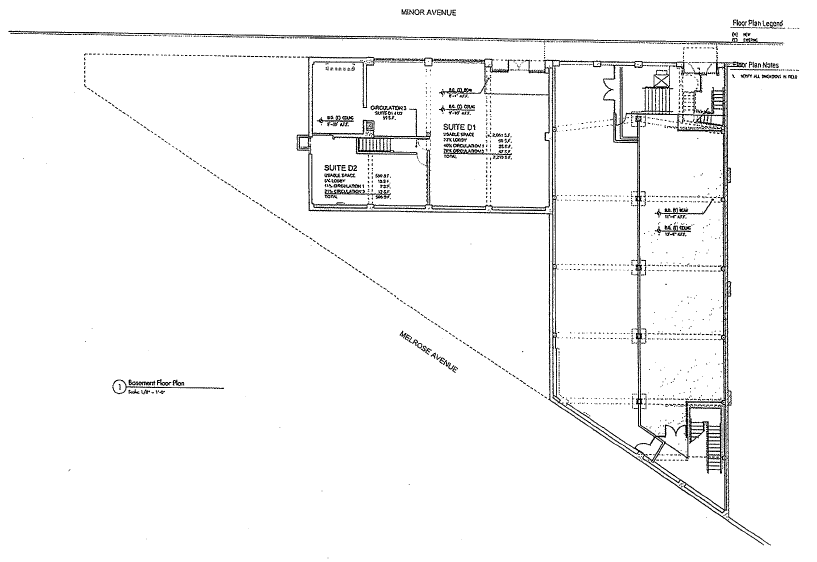 Draft plans showing the restaurant’s lower level — and infamous area D2 where Murphy planned an exclusive private dining room
Waiting for the smoke to clear is Seattle restaurateur Deming Maclise who helped shape Bastille into a major hit in Ballard. Last week, CHS broke the news that a team led by Maclise is lined up to take over the Terra Plata space if Murphy is forced to move on. We called the restaurant project a ‘Mexican Bastille.’ Maclise didn’t like that very much. “It’s definitely not going to be a Mexican French place,” Maclise told CHS. “It’s going to be a totally different concept than Bastille.”
Maclise also didn’t like talking about his project too much with the arbitrator’s decision possibly only days away. “We love the space but, by the way, Tamara still technically has a lease,” Maclise said.
He did tell us that he is teaming with somebody he was worked with at Bastille who will be in charge of operating the Melrose restaurant and that his focus is on planning and designing the space. Deming said elements like the potential for the rooftop garden and other tenants of the Melrose Project like Sitka & Spruce sold him on the space.
Maclise said he’ll be looking for another Capitol Hill location if Melrose doesn’t work out. “We love Ballard. We also love Capitol Hill,” he said. “It’s really the space that dictates it. But obviously the neighborhood is important, too.”
For now, Maclise and his project are in limbo while lawyers and a retired judge dig through declarations, leases and drafting plans.
“Tamara has put a lot of money and time into that space,” Maclise said. “If she ends up getting it, I think that’s great. If she does walk away, I hope both sides are not too injured.”


Very good reporting here.
Thanks for the in depth coverage here. I feel I will no longer be able to simply walk past this location without thinking about this imbroglio. There seems to be a great deal of widespread community good will towards all parties involved (as long as there will be vegetarian options) so it is quite interesting to see and hear about this developing conflict. I can’t quite assign any blame or give one entity a boycott-y black eye in my mind. I envision a happy ending to this where everyone is all reconciled and chummy!
also: where is this Ballard?
Thanks.
Should call it the electricl service panel fiasco.
Liz Dunn will loose …. not that I have a favorite … but high income property which is lesed to an exacting standard is not chaged on a whim to suit the owner or the lazy mechanical contractor.
Sure – dinning room whith a hummm in your ear, sure.
Simple.
I’m not sure why you think Liz Dunn would lose. I don’t see where her motivation is to screw over this tenant.
It does sounds like even with two less seats, the number of seats in the private dining room is still in the accepted range of Tamara’s star witness – Chrisine Keff.
Sounds more like people aren’t willing to compromise or maybe some cold feet.
Contacts speak for themselves. Motive is not a legal defense.
In this high end specialized market – big rents – long periods.
Tenants must get exactly what they contract for.
The dispute will settle with negotiation – neither party wants bad PR.
Liz has the low ball hand.
KPD
You have a favorite in the dispute … contacts are contracts … and this type of agreement is supervised by good attorney advice on both side. Too late to decide the dining room can be fucked up and the business tenant will live with it. No.
Not complicated and the rest does not matter.
(by the way, small private parties spending 100.00 per person or more, love set apart (private) dining spaces … you are out of you league)
Regardless of a private dining room, 100 seats, 5 seats, or if Tamara wanted a meditation room. She leased a space and made her plans according to what she wanted in her restaurant. Who is the landlord to decide that it is OK to put their own mechanical room in her space and try to evict her because she doesn’t just roll with it. It is simply NOT OK. How unfortunate that so much contention has developed. If all parties could find a way to kiss and make up, then put their resources towards their initial intention of building something great for the community such as Terra Plata… we would all benefit. Most importantly, Tamara deserves the opportunity to complete and open her new restaurant after all the time, energy and money she has invested. If I were in Maclise’s shoes, I would not want the Karma of taking taking someone else’s heart, passion and hard work and assuming it for my own. I hope to be on Terra Plata’s roof top in the near future.
Tamara is talented as a chef and is a total asshole as a person. I hate to say it, but there is a universal law that holds us accountable. Karma. She got her space. Did she learn her lesson? Or will she continue to spit unreasonably hateful venom at all of the people who help her succeed? Time will tell.